

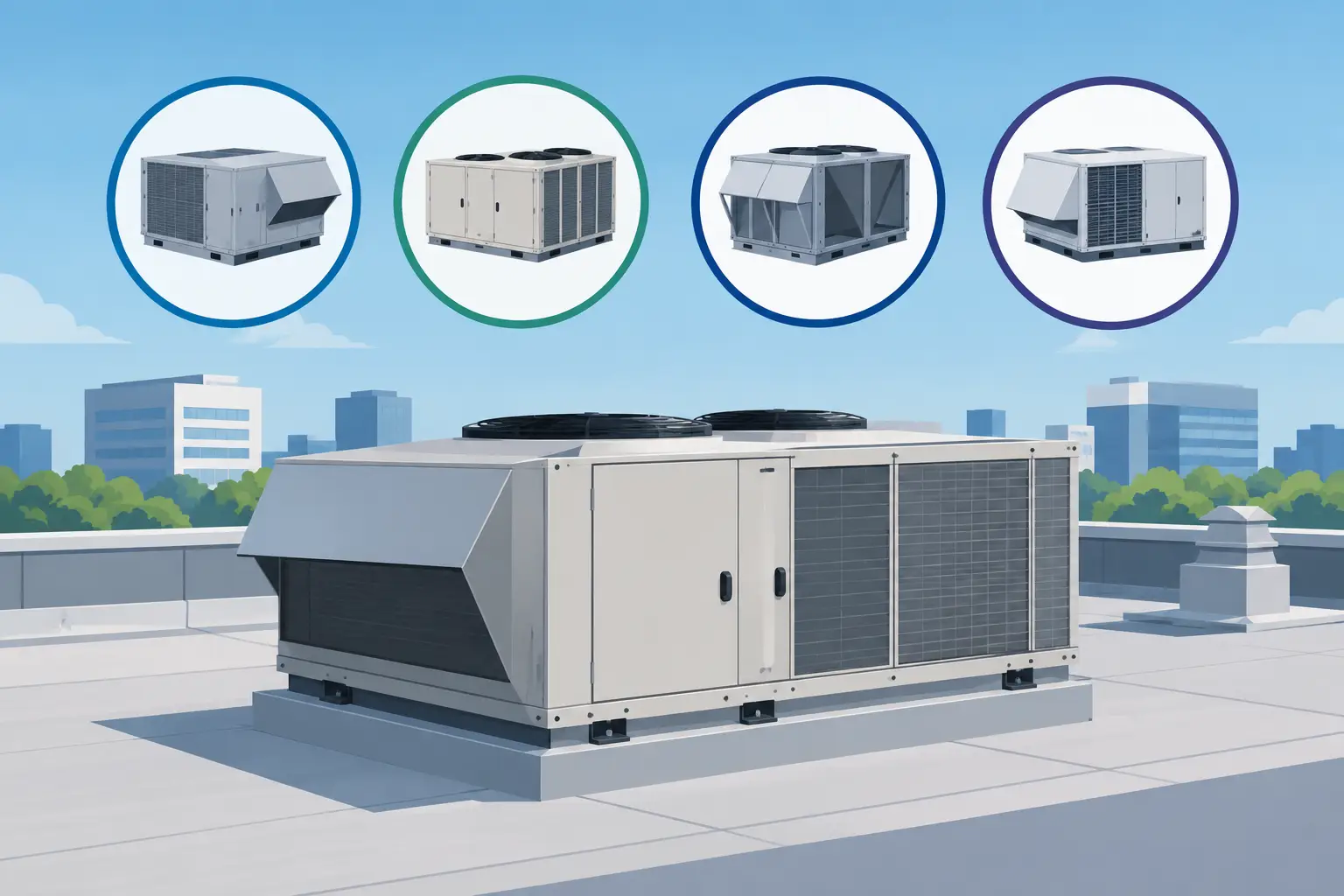
Best Commercial Rooftop Unit Brands Compared
A rooftop unit failure can close a dining room, disrupt a medical office, or make an entire retail floor uncomfortable before the workday is over. When comparing the best commercial rooftop unit brands, facility managers need more than a familiar name. They need equipment sized correctly for the building, supported by available parts and qualified technicians, and built to perform through Maryland heat, humidity, rain, and winter temperature swings.
The right choice depends on your property, budget, operating hours, ventilation needs, and plans for the building. A premium unit with advanced controls may be worthwhile for a large office or school. A straightforward, serviceable model may offer better value for a smaller storefront or rental property. Here is how the leading commercial rooftop unit manufacturers compare and what to consider before approving a replacement.
What Makes a Commercial Rooftop Unit Brand a Good Fit?
A commercial rooftop unit, often called an RTU, combines heating, cooling, and air handling in one cabinet installed on the roof. That convenience also means a poorly selected unit can create long-term problems with comfort, utility costs, access, and repair expenses.
Brand matters, but installation quality and equipment selection matter just as much. Even the most respected unit can underperform when it is oversized, undersized, improperly ducted, or installed without attention to airflow and drainage. Before choosing a manufacturer, evaluate the local service network, replacement part availability, warranty terms, control compatibility, and the contractor’s experience with the specific product line.
For Maryland properties near the Chesapeake Bay, cabinet durability and corrosion protection deserve special attention. Coastal moisture and salt exposure can be hard on outdoor equipment. Buildings with high occupancy, such as restaurants, gyms, churches, and childcare facilities, also need careful ventilation planning rather than a simple like-for-like replacement.
Best Commercial Rooftop Unit Brands for Common Applications
There is no single best RTU for every commercial building. However, several manufacturers consistently offer strong product ranges, dependable performance, and options suitable for different facility requirements.
Carrier
Carrier is a widely recognized choice for commercial HVAC and offers rooftop systems across a broad capacity range. Its product lineup gives property owners options from dependable packaged units for smaller buildings to higher-efficiency equipment with more sophisticated controls.
Carrier can be a practical fit when a property needs a well-supported, mainstream brand and a contractor has experience servicing its equipment. Many facility managers also appreciate the availability of configurations for economizers, ventilation upgrades, and building automation integration. The trade-off is that advanced configurations and proprietary controls can raise the initial project cost, so it is worth comparing the projected operating savings against the upfront investment.
Trane
Trane is often considered for larger commercial properties, institutional facilities, and buildings where long-term durability and controls matter. Its rooftop units are commonly specified for projects that require close attention to comfort, ventilation, and integrated system management.
For a busy medical office, school, or multi-tenant office building, Trane can be a strong option when paired with proper commissioning and preventive maintenance. These systems can be an investment, especially when advanced controls are included. They are best evaluated on lifecycle value rather than purchase price alone.
Lennox
Lennox commercial rooftop units are frequently chosen for their efficiency options and broad product selection. The brand offers equipment suited to smaller commercial spaces as well as more demanding applications, making it a contender for retail, offices, restaurants, and light commercial properties.
A Lennox unit may make sense when energy performance is a central goal and the building’s load profile supports higher-efficiency equipment. As with any brand, verify that the selected model has the right heating capacity, fresh-air capability, and service support for your area. A high-efficiency rating will not deliver expected savings if the unit cycles excessively or the duct system has significant leakage.
Daikin
Daikin has a substantial commercial HVAC presence and is known for a broad range of equipment, including packaged rooftop units and variable-refrigerant systems. For facility managers seeking modern controls, efficient operation, or a coordinated approach across multiple HVAC system types, Daikin is often worth considering.
The right Daikin configuration can be especially appealing for renovations and properties with changing occupancy needs. However, the design process should be thorough. A contractor should confirm whether a conventional RTU, a dedicated outdoor-air solution, or another system type best serves the space. Choosing equipment based only on a brand preference can overlook a better-performing design.
York
York offers commercial rooftop equipment that is commonly used in light commercial and larger facility applications. The brand can be a sensible choice for owners seeking a familiar platform with a range of capacities and configurations.
York equipment is often considered during replacement projects where budget, availability, and compatibility with an existing curb are important. That does not mean every replacement should use the same size or arrangement as the old unit. Buildings change over time. New lighting, occupancy levels, kitchen equipment, insulation, or tenant layouts can all change the heating and cooling load.
Rheem and Ruud
Rheem and Ruud are closely related brands with commercial packaged rooftop offerings that can provide solid value for many light commercial applications. They are often worth considering for smaller offices, shops, houses of worship, and similar properties that need dependable heating and cooling without unnecessary complexity.
These brands can be a strong fit when serviceability, straightforward operation, and budget discipline are priorities. The key is confirming the available features match the facility’s needs. A basic package unit may be appropriate for a low-occupancy space, while a restaurant or gym may require more ventilation control and a different equipment strategy.
Brand Is Only One Part of the Decision
The best commercial rooftop unit brands give owners choices, but the right model comes down to the details of the building. Capacity is the first major question. An oversized RTU can short-cycle, create uneven temperatures, and remove less humidity. An undersized unit may run continuously on the hottest or coldest days and still leave occupants uncomfortable.
Efficiency should also be evaluated in practical terms. Higher-efficiency units may reduce operating costs, but the payback depends on utility rates, equipment runtime, maintenance practices, and how well the system is controlled. A property open twelve hours a day, seven days a week has different economics than a small office used only during standard business hours.
Service access is another factor that is easy to overlook. Rooftop equipment needs safe access for inspections, filter changes, belt checks, electrical testing, and future repairs. If a unit is difficult to reach or surrounded by other equipment, routine maintenance becomes more expensive and less likely to happen on schedule.
Questions to Ask Before Replacing an RTU
Before approving a commercial rooftop replacement, ask the contractor whether they have completed a load calculation or evaluated the building’s actual heating and cooling needs. Ask whether the existing roof curb can be reused, whether an adapter curb is required, and whether the new unit will affect duct connections, electrical service, gas piping, or condensate drainage.
It is also smart to discuss ventilation. Modern code requirements and occupant expectations may call for more outdoor air than an older unit provided. An economizer can help use suitable outdoor air for cooling during mild weather, but it needs proper setup and regular inspection to work as intended.
Finally, review warranty coverage, expected lead times, maintenance requirements, and the availability of replacement parts. A lower initial equipment price can lose its advantage if the unit is difficult to service or causes repeated operational disruptions.
Protect the Investment With Preventive Maintenance
Commercial rooftop units work in harsh conditions. They are exposed to sun, wind, rain, debris, and temperature changes every day of the year. Filters, belts, coils, drain pans, burners, electrical components, and economizers all need scheduled attention.
A preventive maintenance agreement helps identify worn parts and airflow problems before they become an emergency call. It also creates a service history that can support warranty claims and replacement planning. For businesses that cannot afford downtime, maintenance is not an optional extra. It is part of operating the building responsibly.
Bethany Air helps commercial property owners evaluate rooftop unit replacements, maintain existing equipment, and respond quickly when a system fails. A qualified technician can compare options based on your building’s needs instead of steering the decision toward a one-size-fits-all answer.
The best next step is to schedule an on-site evaluation before the current unit becomes an emergency replacement. With accurate sizing, a practical brand comparison, and a maintenance plan in place, your rooftop system can support reliable comfort instead of becoming the next urgent problem on the facilities list.
