

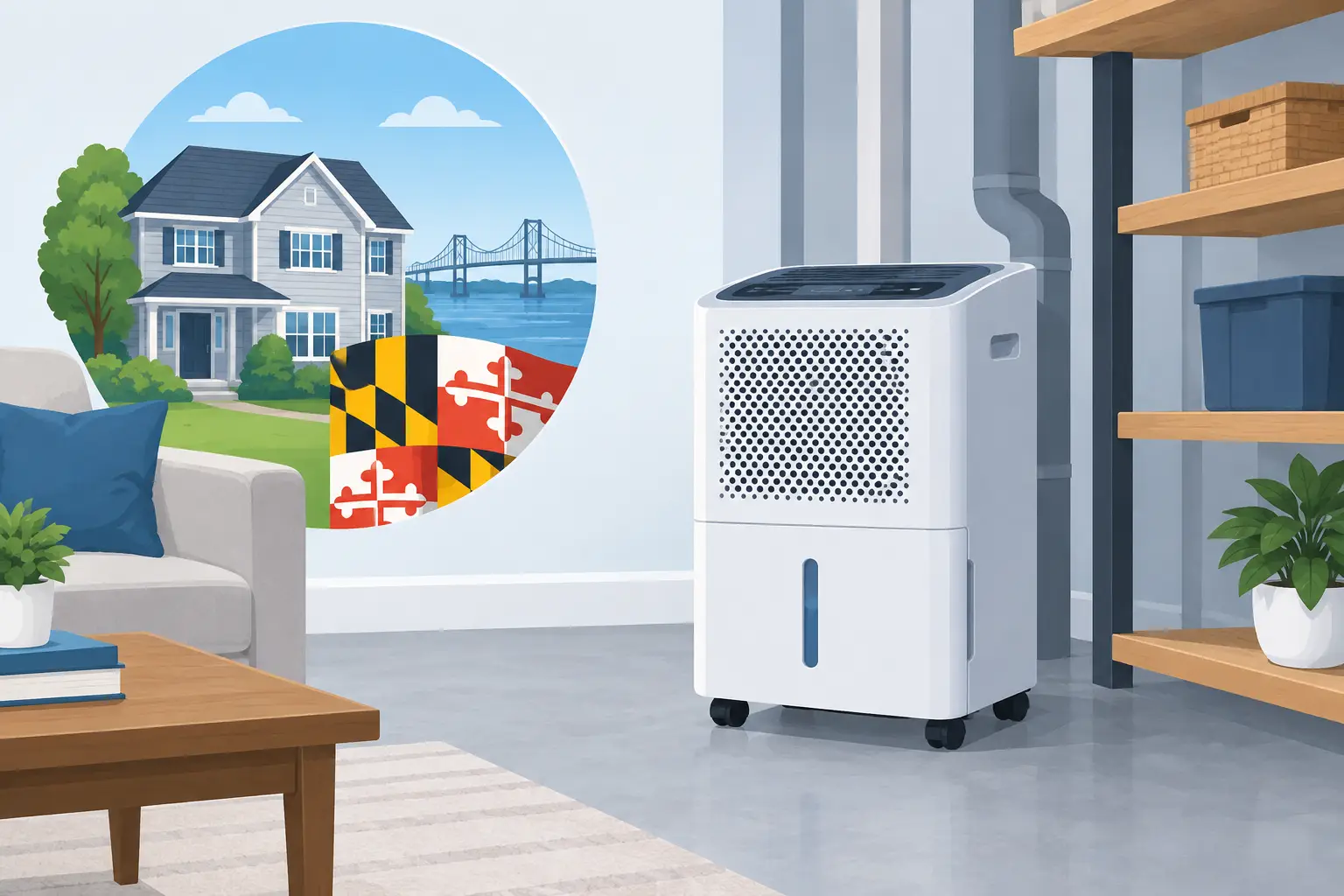
Whole Home Dehumidifier Guide for Maryland Homes
A Maryland summer can make a house feel damp even when the thermostat says the temperature is comfortable. You may notice sticky rooms, musty odors in the basement, condensation on windows, or an air conditioner that seems to run constantly without delivering real relief. This whole home dehumidifier guide explains how a professionally installed system addresses those problems and when it may be the right investment for your property.
Unlike a portable unit that treats one room at a time, a whole-home dehumidifier works with your HVAC system to remove excess moisture throughout the house. The goal is not dry air. It is balanced indoor humidity that supports comfort, protects the home, and helps your heating and cooling equipment operate more effectively.
What a Whole-Home Dehumidifier Does
A whole-home dehumidifier is typically installed near the air handler and connected to your ductwork. It draws in humid indoor air, removes moisture, and sends drier air back through the system. The collected water drains through a dedicated line, so there are no buckets to empty and no portable units taking up floor space.
The system uses a humidistat, either built into the equipment or integrated with a compatible thermostat, to maintain a selected humidity level. For most homes, a relative humidity range of 40% to 50% is a comfortable target. Your ideal setting can vary based on the season, the home’s insulation and air sealing, and whether anyone in the household is especially sensitive to allergens or humidity.
Air conditioning removes some moisture as part of normal operation, but it is not designed to solve every humidity issue. This is especially true during mild, rainy weather, when the AC may not run long enough to pull out sufficient moisture. A dedicated dehumidifier gives your home moisture control even when cooling demand is low.
Signs Your Home May Need One
Persistent indoor humidity is more than a comfort complaint. Over time, excess moisture can affect flooring, wood trim, furniture, insulation, stored belongings, and indoor air quality. It can also create conditions that allow mold and mildew to grow.
Common warning signs include a clammy feeling at normal temperatures, musty odors, visible condensation, peeling paint, warped wood, or recurring mildew in bathrooms and lower levels. You may also find that towels take too long to dry, bedding feels damp, or a basement has a stale odor despite regular cleaning.
An inexpensive hygrometer can give you a clearer picture. If indoor relative humidity regularly remains above 55% or 60%, especially during Maryland’s warmer months, it is worth having an HVAC professional evaluate the cause. High humidity can result from outdoor air leaks, an oversized air conditioner, insufficient ventilation, duct leakage, drainage issues, or moisture entering through a crawl space or foundation. A dehumidifier may be part of the answer, but it should not be used to overlook a building or HVAC problem that needs correction.
Whole-Home vs. Portable Dehumidifiers
Portable dehumidifiers have a place. They can be useful for a small isolated area, a temporary moisture problem, or a single room that needs extra attention. They are often the lower-cost option upfront, but they require regular emptying unless a drain is available, can add noise to living spaces, and may struggle to control moisture beyond the immediate area.
A whole-home model costs more to install because it requires proper equipment selection, duct connections, electrical work, and a condensate drain. In return, it provides consistent treatment throughout the home, operates out of sight, and is generally easier to manage day to day. It can also reduce the temptation to overcool the house just to feel less humid.
For homes with an unfinished basement, some homeowners choose a dedicated basement dehumidifier rather than a ducted whole-home system. That can be a sensible approach when moisture is limited to the basement and the rest of the house maintains healthy humidity. The right choice depends on where the moisture is coming from and how broadly it affects the property.
Sizing Matters More Than Many Homeowners Expect
Dehumidifier capacity is often measured in pints of moisture removed per day, but choosing a unit is not as simple as matching that number to square footage. A properly sized system considers the home’s total conditioned space, existing humidity levels, ceiling height, number of occupants, duct layout, crawl space or basement conditions, and how much outside air enters the home.
An undersized unit may run for long periods and still leave the home humid. An oversized unit can cost more than necessary and may cycle inefficiently. Installation quality matters just as much. The contractor must confirm that the duct connections allow proper airflow, the drain is correctly trapped and routed, and the equipment can be serviced without difficulty.
For commercial spaces, sizing requires an even closer review. Occupancy, door traffic, kitchen or laundry operations, ventilation requirements, and building use can add major moisture loads. A facility manager may need a separate humidity-control strategy for a server room, storage area, medical space, fitness center, or lower-level office.
Where the System Is Installed
Most whole-home dehumidifiers are installed in a basement, utility room, mechanical closet, attic, or crawl space near the HVAC equipment. The best location depends on access, drainage, ductwork, and the equipment manufacturer’s requirements.
The unit needs a reliable way to dispose of condensate. Whenever practical, a gravity drain is preferred. If one is not available, a condensate pump may be used. Because a clogged drain can cause water damage or shut down the system, the drain line should be checked during routine maintenance.
Some systems are ducted directly to the central HVAC return and supply ducts. Others use dedicated duct runs, which can be helpful when the home has unusual ductwork or a specific moisture-prone area. A professional assessment will identify the setup that provides dependable humidity control without interfering with the performance of the furnace, heat pump, or air conditioner.
The Best Humidity Setting for Maryland Homes
For many households, 45% to 50% relative humidity is a practical starting point in summer. It is low enough to reduce the sticky feeling and discourage mold growth, but not so low that the air feels unnecessarily dry. During cooler weather, a different setting may be appropriate because cold windows and exterior surfaces can develop condensation when indoor humidity is too high.
There is no single setting that works perfectly for every home. If you see condensation on windows, lower the setting slightly. If the air feels dry or family members experience dry skin, static electricity, or irritated sinuses, the setting may be lower than necessary. Your technician can help you balance comfort with the home’s conditions.
Keep in mind that a dehumidifier is not a replacement for proper ventilation. Bathrooms should still have functioning exhaust fans, clothes dryers should vent outdoors, and kitchen ventilation should be used when cooking produces significant steam. Addressing moisture at its source helps the system work more efficiently.
Maintenance and Service Expectations
Whole-home dehumidifiers are relatively low-maintenance, but they are not maintenance-free. Most units have an air filter that should be inspected regularly and replaced or cleaned according to the manufacturer’s instructions. A dirty filter restricts airflow and reduces performance.
During annual HVAC maintenance, the technician should inspect the filter, coil, drain pan, drain line, electrical connections, controls, duct connections, and overall operation. If the unit has a condensate pump, that component should also be tested. Routine service helps prevent drain backups and identifies wear before it becomes an inconvenient summer breakdown.
If you notice reduced moisture control, unusual noise, water around the equipment, or a musty smell returning, schedule service rather than waiting. Humidity problems tend to become more expensive when moisture has time to affect building materials.
Is a Whole-Home Dehumidifier Worth It?
A whole-home system is often worth considering when excess humidity affects multiple rooms, a basement, or the entire living area for much of the year. It can improve comfort, reduce the need to set the thermostat unusually low, and help protect the parts of your home that moisture can quietly damage.
The best next step is a professional evaluation, not a guess based on a single symptom. An experienced HVAC technician can measure humidity, inspect your system and ductwork, identify possible moisture sources, and recommend equipment that fits the home rather than simply selling the largest available unit.
For homeowners in Edgewater, Annapolis, and nearby Maryland communities, Bethany Air provides reliable indoor air quality and HVAC guidance backed by more than 20 years of service. A properly designed dehumidification solution can make your home feel better through the most humid months while helping protect it for years to come.
